
Conversion rate optimization (CRO) means getting more of the people who already show up to take the next step – without paying for more traffic.
Fix the leaks in this order: offer → message → page → follow-up → THEN traffic. Traffic is an amplifier. It amplifies a broken funnel too.
Judge the whole chain, not one number – a 91% opt-in rate can still sit inside a funnel that loses money.
Test the big things first. Button colours last.
Back in 2020, I recorded a bunch of short videos about this.
CRO “hacks.” A/B testing. Funnel metrics. How to fix a leaky funnel.
Six years – and a LOT of dashboards – later, here’s what I’d tell you instead.
All in one place. And in the right order.
Because the order is where most people go wrong.
What is conversion rate optimization?
Your conversion rate is the percentage of people who take the action you want.
Opt in. Click. Reply. Buy.
Conversion rate optimization is raising that percentage – so you get more results from the people who are already showing up.
Here’s why it’s such a big deal:
Say 1,000 people visit your sales page every month, and 2% of them buy.
That’s 20 sales.
Get that to 3%, and it’s 30 sales.
Same traffic. Same ad spend. 50% more sales.
And it compounds. Improve the opt-in page by 20%… the sales page by 20%… the follow-up emails by 20%… and those improvements multiply.
Now…
Most people hear “CRO” and think of button colours. Headline tests. Moving the testimonial three pixels to the left.
That stuff isn’t useless.
But it’s not where the money is.
What is a leaky funnel?
Think of your funnel as a bucket with holes in it.
Visitors pour in at the top. Some leak out at the opt-in page. More leak out at the sales page. More after the purchase. More in the emails nobody opens.
And here’s the trap:
When the bucket doesn’t fill up, the obvious fix is to pour in more water.
More ads. More content. More subscribers.
But traffic is an amplifier. It amplifies whatever system it flows into – including a broken one.
If your current subscribers aren’t buying, doubling your list doesn’t double your sales.
It doubles the silence.
I learned this one the expensive way.
A few years ago, I paid a newsletter referral network for new subscribers. Over 4 months, it sent me 2,059 of them, for $720.
They bought from me twice. For a grand total of $188.
That’s 9 cents per subscriber… when my regular subscribers were worth about $20 each.
Was the tool the problem? Partly. (The full story is here.)
But the bigger lesson was this:
More leads only help when the funnel can convert the ones you already have.
So if your funnel is leaking, it’s not because you’re bad at this. Most advice simply starts at the wrong end.
Which funnel metrics should you track?
One number per step. That’s all you need to find the leak.
Here’s the chain, with the numbers from my own best-performing front-end funnel on cold Meta ads traffic:
| Funnel step | What to measure | My number |
|---|---|---|
| Ad | Click-through rate, cost per lead | – |
| Opt-in page | Opt-in rate | 90.51% (248 of 274 visitors), later 91.29% |
| Sales page ($49 handshake offer) | Sales page conversion rate | 17.68% |
| Front end overall | Return on ad spend (ROAS) | 1.23x when I filmed the breakdown (higher now) |
| First follow-up email | Open rate, click rate | 76.3% open, 55% click |
| Your whole list | Revenue per subscriber | About $20 |
Two warnings before you compare yourself to these:
1 – They’re not benchmarks. They’re what ONE funnel did, with one offer, for one audience. Your numbers will be different. Compare yourself to your last month, not to me.
2 – Judge the whole chain. That 90%+ opt-in page sat inside a funnel whose front end returned 1.23x its ad spend at the time. The opt-in rate alone would have told me a much rosier story. A great number at one step can hide a leak at the next one.
(If you run ads, here’s how I read the ad side: Facebook ads metrics explained. The whole funnel, part by part, is here.)

In what order should you fix a leaky funnel?
This is the most important section of this post.
The way I see it, roughly 41% of a campaign’s success comes from the list, 39% from the offer, and about 20% from the copy.
Button colours aren’t even on the chart.
So fix things in this order:
1 – The offer. If the right people don’t want what you’re selling, nothing downstream can save it. Usually it’s an offer built for everyone – which ends up appealing to no one. (Here’s why most offers don’t sell.)
2 – The message. Are you talking to the right person, in their words, about the problem they actually have? (That’s conversion copywriting.)
3 – The page. Opt-in page, sales page, checkout. One reader, one promise, one offer – and nothing that distracts from it.
4 – The follow-up. What happens after someone opts in or buys. The welcome emails. The upsells. The page they see right after the form.
5 – THEN the traffic. Only now does pouring in more people actually pay.

Do it in reverse, and you’re paying – in time or money – to grow a list that ignores you.
Do it in this order, and every visitor you add is worth more than the last one.
Which CRO fixes actually work?
Once the offer and the message are right, these are the fixes I’d look at first. Each one has moved real numbers for me.
Make the page fast. A while ago, I moved my website from cheap hosting to SiteGround – at about 4x the price. My landing pages went from converting at around 45% to 52%. I didn’t change a single word of copy.
Cut every exit. My simplest landing page had a headline, a subheadline, a picture of the book, a button and two testimonials. No menu. No sidebar. It converted at 55%. (The rest of the rules are in my landing page best practices.)
Match the headline to the click. If the ad promises “5 welcome emails written for you,” the page shouldn’t open with “Welcome to my world.”
Put proof right where the doubt shows up. Usually next to the button. The right two testimonials beat the wrong twenty.
Get the offer and the price in front of people early. My “anti-hype” sales page doesn’t open with a long story. It treats the reader like an adult who can make a decision. On cold traffic, it converts at 17.68%.
Offer a payment plan if cash flow is the objection. Sales of my $299 product started slow. Then I added a 3x $99 payment plan – and 83% of buyers took it. (The trade-off: average order value went down. Details here.)
Build a back end. A $49 front-end offer rarely pays for the ads on its own. Order bumps and upsells are what make the math work – and turn a $49 buyer into someone who happily spends a few hundred bucks 15 minutes after meeting you.
Use the page after the opt-in. Most people put a “thanks, check your inbox” page there. I’d rather call it a priming page – and give people a small next step. When I built a campaign around small, conversational first steps – including a page that asked people to hit reply – I got 251 replies from 544 new subscribers. (Here’s how.)

How should you A/B test?
Carefully. And later than you think.
Most people test the small stuff first. Button colours. Emojis in subject lines. 9 am vs 10 am.
Test the big things first instead:
1 – Who you’re sending to.
2 – The offer – including the price, the terms and the bonuses.
3 – The big idea and the headline.
4 – THEN the small stuff.
A few rules that have kept me honest:
Change one big thing at a time. If you change the headline, the price and the image at once, you won’t know which one did it.
Wait for enough data. A test with 30 visitors is a coin toss. My 55% landing page number was measured after about 300 sign-ups – not after 30.
Write down what you tested and what happened. Six months from now, you won’t remember. And you’ll end up testing the same losing idea twice.
No traffic for a proper split test? Test with your emails instead. Send an offer to your list and see who bites before you build a whole funnel around it.
Where do most funnels leak?
If I had to bet on one leak without seeing your numbers…
It would be the first few days after someone signs up.
That’s when a new subscriber is paying the most attention to you – and it’s exactly when most welcome sequences go “thanks for subscribing, here’s your freebie”… and then fall silent until the next promo.
Meanwhile, the bucket keeps leaking.

I see the same 3 problems in almost every welcome sequence I look at. (Here they are: why your welcome sequence isn’t converting.)
What to do this week
1 – Write down your chain. Every step from ad (or post) to sale, with ONE number next to each.
2 – Find the biggest drop. That’s your leak. Fix that one before touching anything else.
3 – Check the offer before the copy. Would the right person want this – even if your page were ugly?
4 – Hold off on more traffic until the funnel converts the people you already have.
And if the leak turns out to be right after the sign-up – one of the most common ones I see – I wrote a short book about exactly that.
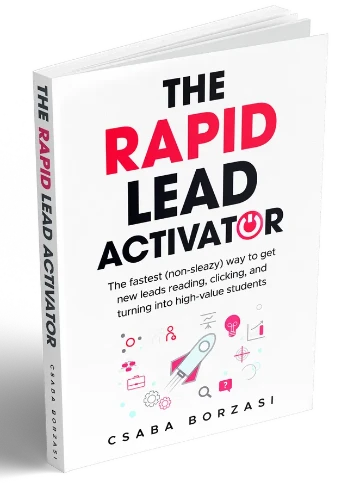
It’s called Rapid Lead Activator. It shows you how to turn the new leads already joining your list into buyers – faster, and without hype. You can read it in under an hour.
Free book + AI assistant
Turn the Leads Already Joining Your List Into Buyers – Faster
The Rapid Lead Activator reveals the psychology-based framework I use to write welcome sequences that sell – without hype. Normally $9.99 on Amazon, yours free. Plus a bonus AI assistant that writes your first 5 welcome emails for you – in minutes, not days.
Send Me the Rapid Lead Activator →-Csaba

