
The 5 stages of customer awareness come from Eugene Schwartz‘s Breakthrough Advertising (1966): Unaware, Problem Aware, Solution Aware, Product Aware and Most Aware.
The more aware your reader is, the shorter and more direct your copy can be. The less aware they are, the more you have to start with them – not your product.
Most copy that flops isn’t badly written. It’s written to the wrong stage.
I first wrote this post back in 2019.
And reading it again in 2026 was… humbling.
(a lot of “funnels” and “Facebook ads” talk, not a lot of what actually matters)
The 5 stages themselves haven’t changed one bit, though.
They’re the same five stages Eugene Schwartz laid out in Breakthrough Advertising back in 1966.
(60 years ago… and still more useful than most marketing books published last year)
What changed is how I USE them.
Because after years of writing emails, sales pages and ads – for my own products and for 100+ clients – I’m convinced of one thing:
Most copy that doesn’t sell isn’t badly written. It’s written to the wrong person at the wrong moment.
That’s what the awareness stages fix.
So let’s go through them one by one… and then I’ll show you which stage I write almost all of my own emails to (it’s probably not the one you’d guess).
What are the 5 stages of customer awareness?
Here’s the short version:
| Stage | What your reader knows | What your copy should do |
|---|---|---|
| 1. Unaware | Nothing. Not even that they have a problem | Start with them – a story, a symptom, an identity |
| 2. Problem Aware | They feel the problem, but don’t know a solution exists | Name the problem better than they can, then hint at a way out |
| 3. Solution Aware | They know solutions exist, but not that yours is the one | Show why YOUR way works – the mechanism |
| 4. Product Aware | They know your product, but they’re not sold yet | Prove it, remove the risk, answer the objections |
| 5. Most Aware | They know it, want it, and they’re waiting for a reason | Give them the offer and a deadline. That’s it. |
Schwartz’s big insight was this:
The headline – the first thing your reader sees – has to meet them where they ARE.
Not where you wish they were.
Write a product-aware headline to an unaware reader and they won’t even know what you’re talking about.
Write an unaware-style story to a most-aware buyer and they’ll get bored and leave… while still holding their credit card 🤦♂️
What is the unaware stage?
Unaware people don’t know they have a problem.
Or more precisely – they don’t think of it as a problem yet.
They’re not searching for anything. They’re not comparing anything. They’re just living their lives.
And that’s why the unaware stage is the hardest one to sell to… by FAR.
You can’t open with your product.
You can’t even open with the problem, because to them, there isn’t one.
So what CAN you do?
You start with something they already care about: a story, a surprising number, a situation they recognise themselves in.
For example, if you sell list reactivation, the unaware person doesn’t say “my list is dying.”
They say “I’ve been busy with clients, I’ll get back to the newsletter next month.”
(famous last words… and yes, I’ve been guilty of this one too)
So a headline like “Reactivate Your Cold Email List!” goes straight over their head.
But something like “What happens to your email list when you go quiet for 8 weeks” might stop them… because it’s about something they’re already doing.
Quick warning, though:
Writing to unaware people is expensive. It takes long copy, lots of education and a big idea.
That’s why most direct response campaigns don’t start here – and most small businesses shouldn’t either (unless you enjoy pouring gasoline on your money and lighting it on fire).
What does problem aware mean?
The problem-aware reader feels the pain.
They know something is wrong… they just don’t know there’s a fix for it. Or they’ve tried a few things and decided nothing works.
They’re usually the ones Googling “how to…” at 11 pm (maybe even you, right now 😉).
This is where the old-school copywriters talk about “twisting the knife” (lovely image, I know) – naming the problem so precisely that the reader thinks “how does this guy know?”
But be careful here.
Agitating the problem is one thing.
Making people feel stupid for having it is another. Shame doesn’t sell – it paralyses. People who feel ashamed don’t buy, they close the tab.
So name the problem, show them you understand it better than anyone, and then give them a little hope:
There IS a way out… and it’s not what they’ve already tried.
A good lead magnet is perfect for this stage, because it moves them one step forward without asking for money (here’s why a free book beats every other lead magnet).
Free book + AI assistant
Turn the Leads Already Joining Your List Into Buyers – Faster
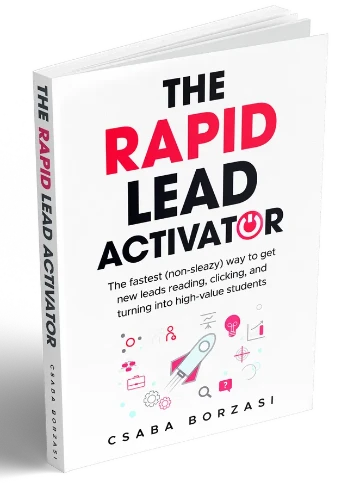
The Rapid Lead Activator reveals the psychology-based framework I use to write welcome sequences that sell – without hype. Normally $9.99 on Amazon, yours free. Plus a bonus AI assistant that writes your first 5 welcome emails for you – in minutes, not days.
Send Me the Rapid Lead Activator →What does solution aware mean?
Solution-aware people know the problem AND they know solutions exist.
They’re shopping.
They’ve read the blog posts, watched the YouTube videos, maybe bought a course or two that didn’t quite work (or one they never finished… which, let’s be real, is most of them).
So the question in their head isn’t “can this be fixed?”
It’s “why should I believe YOUR way works… when the last three didn’t?”
That’s why at this stage you don’t sell the product first. You sell the mechanism – the unique reason your approach works.
That’s exactly why I named my free book the Rapid Lead Activator, by the way.
Think about what goes on in a reader’s head when they see it:
“Yes, I want more leads… oh, what does activator mean? I don’t know… but it sounds intriguing.”
That little curiosity gap is the mechanism doing its job.
What does product aware mean?
Product-aware people know your product.
They’ve seen your page, maybe opened a few of your emails… but they haven’t bought.
And it’s rarely because they don’t want it.
It’s usually one of these:
“I’m not sure it’ll work for MY situation.”
“I’ve bought stuff like this before and never used it.”
“Is it really worth the money?”
“I’ll do it next week.” (the most expensive sentence in business)
So your job here isn’t to explain more. It’s to prove more.
Testimonials from people like them. Specific numbers. A guarantee that takes the risk off their shoulders. Answers to the objections they haven’t even said out loud yet.
This is where most of a long sales page does its heavy lifting.
What does most aware mean?
The most-aware reader is your “shut up and take my money” crowd.
They know the problem, they know the solution, they know your product… and they want it.
They’re just waiting for a reason to act NOW.
So don’t bury them in copy.
Give them the offer, the price, the deadline, and a big fat button.
That’s it, really :)
This is why a cart-close email can be three lines long and still be your best-selling email of the week.
In four of my own launches, the last day brought in 46% to 60% of all sales (full breakdown here).
Those are mostly most-aware people who just needed a deadline to knock ’em off the fence.
Problem aware vs solution aware: what’s the difference?
This is the one people mix up the most… so here’s the simplest way I know to tell them apart:
A problem-aware reader asks: “Why is this happening to me?”
A solution-aware reader asks: “Which fix should I pick?”
The problem-aware person needs you to explain the problem.
The solution-aware person is already past that. Explaining the problem to them feels like you’re wasting their time.
Get this wrong and you lose them either way.
Too much problem talk → the solution-aware reader gets bored.
Too much solution talk → the problem-aware reader gets confused.
Which stage should you write to?
Here’s something that surprised me when I went back and looked at my own data:
357 of the 463 emails that worked best for me in 2025 and 2026 were written to solution-aware readers – or further along.
Not unaware. Not problem aware.
Why?
Simple – because of who’s on my list.
The people who buy from me are experts who already have a business, an audience and real results. They don’t need to be told that email matters. They know.
What they need is a better way – and proof that it works.
Your list might be different. But here’s the rule I use:
Write to the stage MOST of your readers are in right now – not the stage you wish they were in.
If you’re not sure, look at the questions people send you.
“How do I…” questions usually mean problem aware.
“Does your thing work for…” questions mean solution or product aware.
“When does the cart open?” means… well, you know what that means 😉
How do you use the awareness stages in your marketing?
Each part of your marketing has a different job:
Content and ads to cold audiences → mostly unaware to problem aware. Start with the reader, not the product.
Lead magnet and welcome emails → move people from problem aware to solution aware. Show them a better way. (If yours isn’t doing that, here’s why.)
Your regular emails → solution aware to product aware. Teach, tell stories, show proof, point to the offer.
Your sales page → product aware to most aware. Prove it, remove the risk, ask for the sale. (Here’s how I write one.)
Deadline emails → most aware. Short, clear, a real reason to act today.
And remember – your reader can jump stages.
A good story can take someone from unaware to most aware in a single email. It doesn’t happen often… but when it does?
Ooooh, it’s beautiful.
The mistake I still make
Confession time…
I still get this wrong sometimes.
I have a bad case of the curse of knowledge. I assume people know way more than they actually do, so I skip the steps that feel “obvious” to me.
The result?
Copy that’s perfect for the most-aware reader… and completely confusing for everyone else (my own emails included… ask me how I know 🤦♂️).
So before I write anything now, I ask myself one question:
“Where is this person right now – and what’s the ONE thing they need to hear to move one step closer?”
Not five steps.
One.
That question alone has saved me from more flops than any copywriting formula I know.
Free book + AI assistant
Turn the Leads Already Joining Your List Into Buyers – Faster
The Rapid Lead Activator reveals the psychology-based framework I use to write welcome sequences that sell – without hype. Normally $9.99 on Amazon, yours free. Plus a bonus AI assistant that writes your first 5 welcome emails for you – in minutes, not days.
Send Me the Rapid Lead Activator →-Csaba


Csaba, you’re freaking awesome. I got everything I need to know about customer awareness journey in one read. Definitely sharing this.
Thanks a bunch, Lateef – appreciate it!