
Emotion drives action, and logic shows up later. You can’t argue people out of a deep belief, so build a case instead of trying to convince. Clarity and simplicity beat clever copy, market insight beats copy tricks, and most people don’t need more information – they need more conviction. Those are a few of the 38 lessons below, on persuasion, writing, offers and life.
I turned 38 in February 2026.
And for some reason, instead of thinking about my bday as a normal person, my brain immediately went:
“Cool, time to write a list of my biggest AHAs I’ve learned so far”
So here are the 38 things I’ve learned in my 38 years on this planet.
Some of these are personal…
Some are about marketing…
About life in general…
And various things mixed in between.
But ALL of them are things I wish I discovered sooner :)
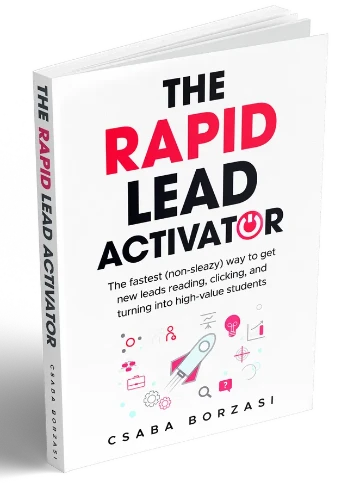
Free book + AI assistant
Turn the Leads Already Joining Your List Into Buyers – Faster
The Rapid Lead Activator reveals the psychology-based framework I use to write welcome sequences that sell – without hype. Normally $9.99 on Amazon, yours free. Plus a bonus AI assistant that writes your first 5 welcome emails for you – in minutes, not days.
Send Me the Rapid Lead Activator →Why can’t you argue people into a new belief?
1 – If someone believes something deeply, it’s almost impossible to argue them out of it
The more proof you shove at them, the more their identity digs in… so if you want to change minds, you usually have to change the emotional story underneath their belief first.
2 – Emotion drives action, and logic shows up later once they’ve already decided
People LOOOVE to think they’re rational… but most buying decisions start as a feeling and then get dressed up as “logic” (which is why emotional copy beats clever copy almost every time)
3 – Tiny improvements done consistently beat heroic effort done occasionally
If you actually get 1% better most days, you wake up a year later and barely recognize the old you… and that is wildly more reliable than waiting for motivation to strike like lightning.
4 – Enter the conversation already happening in their mind, or you’ll feel pushy even when you’re right
Cold prospects do not want a lecture on a new problem… they want you to name the thing they already feel, and then SHOW them the missing piece they did not have.
5 – How you do anything is how you do everything
I fought this mantra when I first heard about it because I wanted to give everyone the benefit of the doubt… but then life repeatedly showed me that patterns are patterns for a reason :). Remember this.
6 – Your job is not to “convince”… your job is to build a case
When you try to convince, people feel cornered. But when you stack a “prosecutor-style” argument with claims, proof, and clear benefits, that usually quietly does the selling for you (unless you’re dealing with people who are indoctrinated by something)
What matters more than clever copy?
7 – When people tell you who they are, better believe them!
Look… wishful thinking is VERY expensive. It’s expensive because it makes you rewrite reality itself in your head until the invoice comes due in pain, time, or money (or all three). This was a painful lesson for me to learn.
8 – Simplicity scales… while complexity kills
If your message cannot be understood instantly, it will NOT convert. Simple as that. And no amount of “but it’s complicated” will save you from confused prospects and weak results.
9 – Calculated risks are often safer than playing it safe
I grew up around extreme risk aversion, and I get why that was adaptive in a different world… but these days, refusing to take smart risks is its own form of slow-motion self-sabotage.
10 – Market insight beats copy tricks every day of the week
The more deeply you understand the customer’s emotions, biases, and past attempts, the less you need “genius writing” because your words start matching their inner monologue. Most “copy problems” are actually “empathy problems” wearing a fake mustache.
11 – Life is 10% what happens to you & 90% how you respond to it
Unless you’re dealing with a real existential emergency, most misery comes from our nervous system hitting the panic button too fast. Learning how to pause that visceral reaction is basically a superpower.
How do you write an email that actually lands?
12 – One email should do one main job (or it does three jobs badly)
If you cannot summarize the point of the email in one sentence, your reader will feel that fuzziness and drift away, even if they like you.
13 – Life isn’t about finding yourself… it’s about creating yourself
You do not “find” your passion like a hidden object in a video game. You build it by investing energy into something until it starts investing energy back into you. It’s a gradual process.

14 – If you want to write emails faster, write them backwards
Start with the CTA… and then ask what someone would need to believe, feel, and understand before taking that step. This way, you will stop writing those long warm-up intros that never land ;)
15 – The world is changing so fast that fundamentals are the ONLY real anchor
When you’re overwhelmed by a seemingly endless barrage of NEW tools, trends, and hot takes, coming back to how humans decide, desire, fear, and trust will keep you sane and effective. Platforms change… but insecurity, status, belonging, and hope are stubbornly consistent!
What makes people believe you?
16 – Belief is first engineered through emotional story… THEN logical trust… and THEN through action momentum
People do not buy because they fully understand your offer. They buy because they accept a NEW STORY about themselves and what’s possible for them. Once they emotionally “step into” that story, the facts stop feeling like persuasion… and start feeling like confirmation.
17 – We’re entering an age of fakeness, so your internal compass matters more than ever
As trust in institutions and influencers collapses, the ability to notice “this feels off” becomes a legitimate life skill. And the people who ignore that signal pay for it repeatedly. If your body feels tense while someone is “pitching” anything (including me!), take that as helpful data.
18 – Specificity is a great Proof point on its own, while vague claims are just expensive wishes
You do not need a 10-page case study in every email, but you do need credible micro-proof and specific detail, because specificity is what makes belief feel safe. Even a tiny “here’s what happened on Tuesday” detail can outperform a giant generic promise.
19 – If you can’t sell on emotion ethically, you probably shouldn’t sell that thing
The goal is to tap into real existing desires, validate what’s true for the reader, and then offer a clean path forward… NOT to exploit insecurity and call it “marketing”. There are plenty of snake oil salesmen out there already… don’t be one of them!
That’s it for the first 19.
Some of the next ones are even weirder :)
And some are the kind of thing you only learn after you ignore painful lessons 3-4 times in a row 😅
Why don’t people act on what they already know?
20 – Most “problems” are usually symptoms, NOT the root cause
If you treat symptoms, you get temporary relief. But if you find the root cause, you get a permanent upgrade. This applies to business, relationships, health, and basically everywhere else.
21 – Most people do not need more information… they need more conviction
At some point, they already know what to do, but they do not trust themselves enough to do it for real (and consistently). So one of the keys is helping them feel safe taking action.
22 – If you try to please everyone, you become forgettable to everyone
I know this is controversial, but it’s true. Clear opinions repel a lot of people, yes… but they also attract the RIGHT people to you (while automatically eliminating the wrong ones). In most cases, that’s win-win.
23 – Clarity beats persuasion (almost) every single time
When your message is clear, your reader can relax… and relaxed people make decisions faster than confused people who feel like they need to keep “thinking about it”.
24 – Your offer should be a filtering mechanism, instead of a “net”
A good offer does not try to catch everyone… it catches a specific kind of person who wants a specific kind of outcome and is willing to do the specific kind of work. That’s why ICPs are so important.
25 – Consistency is a “self-trust” issue disguised as a “strategy” issue.
I believe most people aren’t inconsistent because they’re lazy… they’re inconsistent because they do not believe their effort will pay off. It’s a belief/confidence issue. The result? They often quit right before the compounding starts.
Why should your emails sound like a real person?
26 – Your emails are not “newsletters” (God, how much I hate that word!)… they’re “relationship deposits”
This is actually pretty simple: if most emails you send feel like a transaction, people might buy, sure… but you won’t be successful for long. But if your emails feel like an ongoing relationship, your selling becomes natural (instead of awkward).
27 – The inbox punishes perfectionism
If you wait until it’s “ready,” you will ship rarely… and the people who ship imperfectly but consistently will steal your attention, your customers, and your confidence. Remember that!
28 – In a way, good positioning is saying “NO” out loud
The fastest way to become the obvious choice is to be specific about who you are NOT for… because that makes who you actually are for feel seen and heard.
29 – The easiest way to write more is to stop trying to sound smart
When you write like a human, you get replies, and replies create more ideas, and ideas create more emails, and suddenly consistency is no longer a personality trait… but a semi-automated system :)
30 – “I don’t have anything to say” usually means “I’m censoring myself”
If you have opinions, stories, frustrations, and tiny observations, you have plenty of material for all sorts of content marketing. But the main thing that usually blocks us from sharing this with the world is the fear of being judged for being real.
31 – A single concrete example can do more work than 10 abstract claims
Specificity often makes people feel like you actually know what you’re talking about because you can point to reality, not theory.
Why do people say no to things they want?
32 – Most objections are actually “identity protection”
People resist because buying would force them to admit something about themselves… so your job is to lower the Ego threat and raise the emotional safety. Sounds easy in theory… but it’s so soooo hard in practice 😅
33 – The best marketing is often just empathy with better sentence structure
When you can name what they’re thinking in a way they’ve never heard before, it feels like mind-reading, and mind-reading is basically like a cheat code for trust.
34 – If you want more sales, stop hiding the ask
A lot of “low conversion” is just low courage, because the reader cannot buy what you never clearly offered. Make more offers.
35 – If you rely on “motivation” to do stuff, you’re gonna lose
Motivation changes hourly, but systems run even when you are tired, distracted, or mildly annoyed at the entire universe.
36 – Your brand voice is a priceless asset (so protect it like one)
In the age of slop, sounding like a REAL person with a REAL personality (even if it’s imperfect… heck, especially if it’s imperfect!) is one of the last unfair advantages left.
37 – Most people are not afraid of failure itself… they’re afraid of regret
They can handle trying and falling short, but they struggle with the idea that they did not even try. And so the cleanest way to act is to ask, “What will future me hate me for NOT doing?”
38 – Life rewards the people who can stay kind without staying naive
You don’t have to harden into a cynic to be wise… but you *do* have to learn boundaries, discernment, and the ability to walk away when the pattern is clear. And that holds especially true for toxic people.

Whewww….
Quite an exhaustive list, wouldn’t you say? :)
If I get to live until 100, I might have to break that list down into at least 5-7 parts.
But who knows what medium of communication we’ll be using by then, haha.
In any case, hope you enjoyed these 38 insights.
I certainly enjoyed sharing them!
How to put 5 of these to work this week
1. Write your next email backwards. Start with the CTA. Then ask what your reader would need to believe, feel and understand before taking that step.
2. Give it one main job. If you can’t sum up its point in one sentence, your reader will feel the fuzziness and drift away.
3. Swap one vague claim for one concrete detail. A tiny “here’s what happened on Tuesday” can beat a giant generic promise.
4. Make the ask clear. Your reader can’t buy what you never clearly offered. (On a sales page, that means building a case, not a pitch.)
5. Say who you’re NOT for. That’s what makes the right people feel seen and heard.
If you want those fundamentals – how people decide, desire, fear and trust – on hand every time you write, my Conversion Operating System (COS) is 200 pages of tested conversion strategies and marketing frameworks you plug into your AI tool.
Related: The Curse of Knowledge: Why Experts Overcomplicate Courses
Free book + AI assistant
Turn the Leads Already Joining Your List Into Buyers – Faster
The Rapid Lead Activator reveals the psychology-based framework I use to write welcome sequences that sell – without hype. Normally $9.99 on Amazon, yours free. Plus a bonus AI assistant that writes your first 5 welcome emails for you – in minutes, not days.
Send Me the Rapid Lead Activator →-Csaba

