
Because most people use AI as their foundation instead of a layer on top of one. With no principles underneath – no idea WHY a piece of copy persuades anyone – you get “vibes-based prompting” and output that looks fine but doesn’t sell. Put AI on top of tested direct response principles, and the same tools take your output from 30/100 to 90/100.
Here’s a quick thought experiment:
Think back to the last time Claude or ChatGPT went down for a few hours.
(Which happens like clockwork these days… every other week or so)
Now pull up any marketing community you’re in…
Scroll back to that day…
And watch what happened:
Mass Panic 😱
Ad campaigns paused.
Sales pages broken.
Content calendars frozen.
Full-blown launches stalling out because the one-click prompt template someone paid $97 for last month suddenly stopped producing the same output it used to!
People posting in genuine crisis mode:
“Is anyone else’s workflow completely down?!”
“How am I supposed to write new ads today?!”
“I literally cannot do my job right now….”
Meanwhile…
The last time Claude went down, I just… kept working.
Not because I’m some genius (I’m not).
But because AI isn’t my foundation…
It’s the layer on TOP of my foundation.
Free book + AI assistant
Turn the Leads Already Joining Your List Into Buyers – Faster
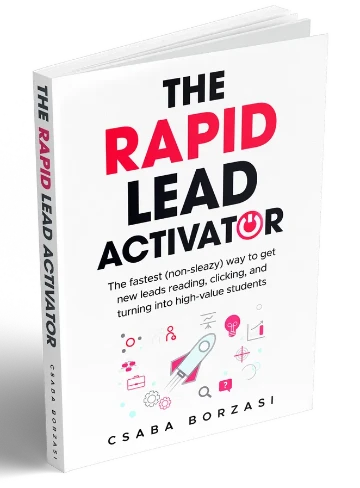
The Rapid Lead Activator reveals the psychology-based framework I use to write welcome sequences that sell – without hype. Normally $9.99 on Amazon, yours free. Plus a bonus AI assistant that writes your first 5 welcome emails for you – in minutes, not days.
Send Me the Rapid Lead Activator →What’s the difference between using AI and depending on it?
And that’s a BIG difference right there.
Because here’s the thing…
When I sit down to write an email or build a sales page or design a campaign…
The actual strategy comes from 100+ years of tested direct response principles I’ve spent over a decade studying.
(Eugene Schwartz. Gary Halbert. Gary Bencivenga. Clayton Makepeace… and so on. The masters most “marketers” today have never even heard about!)
The AI just helps me execute faster.
So if Claude or ChatGPT goes down?
Okay…. I pull out my notes and do it the “old-fashioned” way.
The work still gets done.
But here’s what I’ve noticed about a LOT of people in our space right now:
They DO NOT have a marketing system.
Quite the contrary… they have a dependency problem.
And it gets even worse when you look at what these people are actually putting OUT into the world

And this goes up to the highest echelons of business, too.
Case in point:
In April 2026, even one of the US’s most respected law firms, Sullivan & Cromwell, got busted.
If you don’t know them, they’re a 140-year-old Wall Street law firm with roughly 900 attorneys.
They literally advise OpenAI – yes, that OpenAI – on AI governance and “safe deployment”
So you’d think they’d know better…
But guess what?
They got caught submitting hallucinated case citations to a federal judge in a bankruptcy filing.
Made-up cases…
Fictional legal sources…
Fabricated quotes…
…by the very firm that counsels OpenAI on responsible AI use 😂😂😂
(Looord have mercy!)
So this isn’t just a few sloppy lawyers…
This is a pattern.
And it’s the EXACT same pattern I see across our world
Just with lower stakes (so far)
Marketers, copywriters, agency owners…
All racing to “AI everything” right now.
But the truth is…
Most of them are building on NOTHING.
No foundation.
No principles.
No proven frameworks.
No deep understanding of WHY a piece of copy actually persuades someone to buy.
It’s just… vibes-based prompting.
“Hey ChatGPT, write me an email that converts!”
“Hey Claude, write me a sales page!”
(Okay, maybe at this point they’re a bit more sophisticated… but you get the point)
And then they ship whatever falls out of the slot machine.
What is the “Slop Factory”?
I’ve started calling these folks…
The “Slop Factory”
Not as an insult…but more as an observation lol.
Because the output looks the same wherever you go:
Emails that nobody opens…
Sales pages that nobody reads…
Ads that nobody clicks…
And content that nobody remembers 5 minutes after they scroll past it.
And the worst part?
Most of them don’t even realize how much damage this is causing others (as well as them).
They think they’re being “efficient”.
They think speed = success.
They think prompts = principles.
But in reality…
Paper houses, all of ’em!
Pretty enough to take a photo of (usually with some shiny “I made $10k with AI in 30 days” claim attached)…
But the second the wind picks up…
Or the AI tool changes its model behind the scenes (which happens more often than people realize)…
The whole thing collapses.
Is AI actually good at real marketing work?
Earlier this year, I saw a study that put numbers on this disconnect in a brutal way.
Instead of giving AI “benchmarks” that look like school exams (like the famous “Humanity’s Last Exam”), the researchers gave AI actual paid jobs.
Not simulated jobs…
Not “answer this trivia question”…
REAL jobs made up of real briefs, real requirements, and real deliverables.
You know…
The kind of work someone paid for on Upwork.
So think video editing.
Graphic design.
CAD.
Game dev.
Audio work.
Architecture.
All the messy, annoying, real-world stuff where clients are picky, files break, requirements are unclear, and “close enough” still gets rejected.
Then they gave the AI the exact same brief and any attached files the human had.
And then they asked humans to judge the AI output the way a reasonable client would judge it.
Meaning: Would you accept this and pay for it?
And the result was…
brutal!
Across 240 jobs, with an average payout of about $630, the best performing AI agent at the time only produced acceptable work around 3.75% of the time (!)
Which means, in plain English:
It failed about 96.25% of the time!
(Update, October 2026: the top score on the Remote Labor Index leaderboard is now about 21%. Better… but the best agent still fails roughly 4 out of every 5 real jobs.)

And the failures weren’t subtle.
No no no.
Sometimes the AI delivered corrupt or empty files.
Sometimes it delivered the wrong format.
Sometimes it submitted incomplete work (like an 8-second video when the brief asked for 8 minutes).
Sometimes it technically delivered something “complete”… yes, but the quality was not professional.
Now…
Before anyone starts frothing at the mouth, I’m NOT saying AI is actually crap and the “this is all a sham” crowd is right.
The same study found areas where AI actually did better.
It was stronger at idea generation, for example…
It did okay in certain writing tasks.
It did well at data retrieval and scraping.
So how can both things be true?
Here’s my current take:
I think most benchmarks reward “sounding right”…
But REAL work rewards “being right”
Most benchmarks are like Jeopardy…
But REAL work is like cooking during a dinner rush when the stove is half broken… and the customer is gluten-free AND also angry.
Because AI amplifies whatever you bring to it.
If your thinking is fuzzy… the output is fuzzy.
If your positioning is unclear… the output is vague.
If your standards are low… it HAPPILY hands you a pile of polite garbage and calls it a day.
Should you stop using AI for marketing?
Now…
Before someone says something like:
“See, Csaba, this is why I refuse to use AI at all…”
That’s NOT the answer either.
Refusing AI right now is like refusing the printing press in 1450.
You’re going to get OBLITERATED by the people who use it well.
So the trick isn’t to avoid AI…
The trick is to use it on top of real principles.
Look…
AI is one of the biggest gifts our industry has ever been given.
Sooooo many things that used to take days now take 30 minutes.
That’s not a bad thing…
That’s a massively GOOD thing (or at least it can be).
But it *only* works if the foundation underneath is solid
If you’re using AI tools built by people who actually understand the principles of persuasion…
If you’re using tools that encode decades of tested direct response wisdom into the prompts and frameworks themselves…
(Even better, they add a guided step-by-step component to make everything more user-friendly… which I started doing more and more of in my newer tools)
Then yeah, you get the gift.
You go from 30/100 quality output…
…to 90/100 quality output with your AI, in a fraction of the time.
BUT…
If you’re using generic prompts you found on Twitter…
Or one of the 47 new “AI copy tools” that launched this month…
Or if you’re just throwing your sales page into ChatGPT and hoping it spits out something usable…
Then I’m sorry, my friend…
But you’re building a “paper house”
And no amount of “but it’s faster!” is going to save you when it collapses.
How to put a foundation under your AI (this week)
1. Write down the principles you actually use. How you pick an angle, what makes a headline work, how you handle objections. If it’s not written down, your AI can’t use it either.
2. Give the AI your best past work as the standard. Not “write me an email that converts” – “here’s what good looks like for me”.
3. Make it explain WHY. Ask which principle each choice is based on. If it can’t say, it’s guessing.
4. Run one task this week without AI at all. If you can’t, that’s your dependency problem – and the thing to fix first.
The Conversion Operating System (COS) is one of the tools I’ve built specifically to solve this paper-house problem.
It encodes decades of tested direct response wisdom into a system you can use with any AI tool you want.
It’s NOT a prompt pack… but a true foundation.
Free book + AI assistant
Turn the Leads Already Joining Your List Into Buyers – Faster
The Rapid Lead Activator reveals the psychology-based framework I use to write welcome sequences that sell – without hype. Normally $9.99 on Amazon, yours free. Plus a bonus AI assistant that writes your first 5 welcome emails for you – in minutes, not days.
Send Me the Rapid Lead Activator →-Csaba

